
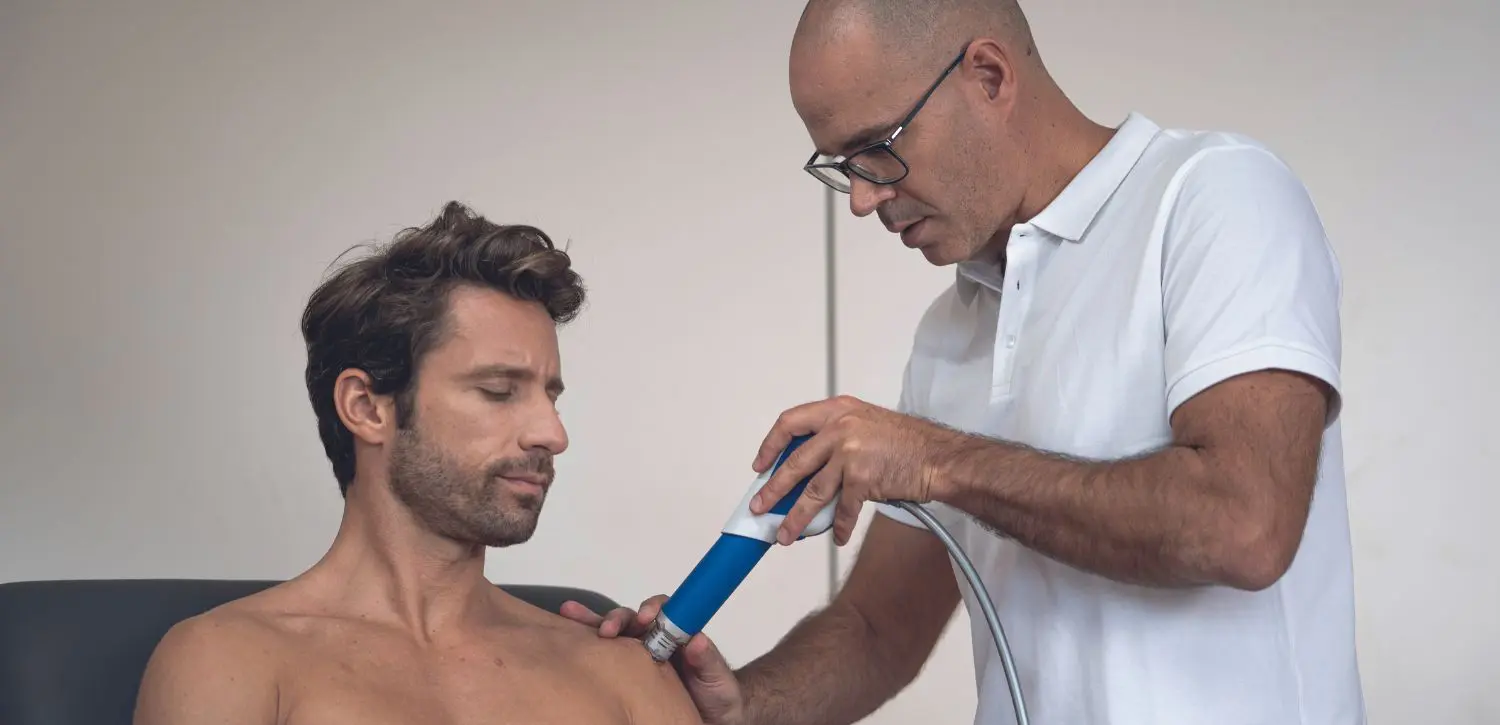

Already back in 1980, the first kidney stone patient was treated with extracorporeal shock wave lithotripsy, thereby minimally invasively relieving him of his suffering. Subsequently, another 200 patients were successfully treated, and in 1983 the first serial device for shock wave therapy was introduced to the public. Back then, the procedure was limited only to kidney stones, whereas today the treatment encompasses the entire urinary tract and is continually being expanded to other areas. Meanwhile, extracorporeal shock wave therapy (ESWT) is approved for the treatment of soft tissue pain such as plantar fasciitis and lateral epicondylitis and many others. Most recently, the use of shockwave therapy devices tested as biotechnical remedies with promising preliminary results. Even patients with long COVID syndrome or erectile dysfunction benefit from shockwave therapy.
Depending on the intended application, a distinction is made between extracorporeal shock wave therapy (ESWT) devices, extracorporeal shock wave lithotripsy (ESWL) devices, and radial shock wave therapy (RSWT) devices. The ESWT method is used for focused shock waves on the musculoskeletal system. In ESWL therapy, focused shock waves destroy kidney stones. RSWT is a registered trademark of the company EMS for the radial DolorClast method.
In this post, we assume MTR however, they focus exclusively on the therapeutic technologies of radial and focused shockwave therapy devices and review their effectiveness so that you can treat your patients in a targeted manner with the right device and the right technology.
Shockwave therapy devices are particularly helpful in modern medicine and therapy because body tissue can be treated without surgery. In orthopedics in particular, there is a wide range of proven areas of application for shockwaves. Numerous scientific studies now confirm the effectiveness of shockwave therapy as an effective treatment method. The general principle of action is based, among other things, on metabolic stimulation and the improvement of blood circulation in order to effectively reduce inflammation. Radial shockwave therapy devices involve a procedure that transmits mechanical pressure waves to specific areas of the body. With focused shockwave therapy devices, the therapeutic focal point within the body can be precisely determined. The most common areas of application for ESWT are chronic musculoskeletal pain conditions in tendinopathies – including those with calcification, myofascial conditions with trigger points, as well as bone fractures and pseudoarthrosis. Through the use of shockwaves, calcifications can be reduced, tendon insertion inflammation can be treated, or poorly healing bone fractures can be regenerated.
Devices for radial and focused shockwave therapy cover the following areas of application:
The duration and frequency of treatment depend heavily on the specific condition. As a rule, three to six sessions should be conducted at intervals of one to a maximum of two weeks.
The ESWT procedure is also used to relieve chronic pain. Mechanical stimulation of the fast sensory nerve fibers activates segmental pain-inhibitory reflexes (e.g., the gate control mechanism) and increases the levels of substance P. This leads to:
Equipment for the Radial Extracorporeal Shock Wave Therapy (rESWT) (radial extracorporeal shock wave therapy) has been used successfully since the 1990s for the noninvasive treatment of tendinopathies, muscle injuries, and rehabilitation to aid in the healing of bone fractures. With the radial method, the shock waves penetrate the body over a specific area and spread radially within it. The shock waves are generated by a piston in the handpiece. The force—or pressure—for the piston stroke is generated by a compressor. Compared to focused therapy, radial shock wave therapy has a shallower penetration depth. Radial devices achieve a penetration depth of 1–4 cm.

Advantages of radial devices:
Different applicators determine the treatment area. However, due to the mechanical drive and high frequency (up to 25 Hz), the noise level during radial shock wave therapy is higher, and the treatment is somewhat more painful than with focused therapy. Radial shock wave therapy is particularly suitable for treating muscles and tendons in the upper tissues.
MTR – Health & Spa AG offers high-quality devices for radial shock wave therapy from the DolorClast® brand by EMS (Electro Medical Systems). Unlike other manufacturers, the shockwave therapy devices With this manufacturer's handpiece, the pulse energy remains constant throughout the entire treatment. With other handpieces, the energy decreases over time, and as a result, the effectiveness of the treatment also diminishes.
With devices based on the DolorClast® method, you’ll benefit from:
The new treatment approach “Guided Dolorclast®-Therapy (GDT)“also offers a holistic therapy concept with a unique high-performance laser for advanced pain relief and reduction of inflammation.
Equipment for the Focused Shock Wave Therapy (ESWT) (Extracorporeal Shock Wave Therapy) works with pinpoint accuracy—that is, in a focused manner. The focused shock waves from the PiezoClast and PiezoWave2 shock wave devices are directed at a focal point inside the body; depending on the gel pad used, this focal point is located at a greater or lesser depth.
The therapy source generates the pulses piezoelectrically: Approximately 1,000 crystals are placed inside the therapy source, which transmit the electrical pulses to the gel pad located in front of it. From there, they are then transmitted to the body. The focused shock waves thus travel from the width of the gel pad toward a predetermined point of intersection within the body. This variant is therefore the exact opposite of radial shock wave therapy.

Advantages of focused devices:
Focused shock wave therapy allows for highly precise treatment and much deeper penetration. Various gel pads are available, with penetration depths ranging from 0.5 cm to 10 cm. With piezoelectric pulse drive, the treatment requires a lower frequency than with other devices. As a result, focused devices operate much more quietly than radial ones. In addition, the gentle transmission of the pulses through the gel pads causes less pain for the patient. And last but not least: due to its higher energy, the focused shock wave is even more effective than the radial one. The only drawback: These devices are significantly more expensive to purchase than radial devices. MTR also offers you a professional selection of devices from PiezoWave2 and EMS for this shock wave technology.
While EMS has only one focused device on the market, the PiezoWave2T, for example, offers needs-based device combinations and shines with the following highlights:
There are now numerous scientific studies that demonstrate the effectiveness of radial shock wave therapy. These include studies of patients with chronic plantar fasciitis, multiple sclerosis, and painful hypertension. In one study in which patients with heel spurs were treated using the rESWT method, good to very good results were achieved in 80 % of the patients. Similarly, results reported by various authors regarding the treatment of patients with treatment-resistant lower back pain and headaches showed improvement rates of up to 80 %. In addition to the traditional indications for shock wave therapy, rESWT is also highly effective for trigger point treatment.
Particularly the radial shock waves generated by the DolorClast® shock wave therapy device meet the therapeutic criteria required in the scientific literature for shock waves used in treatment.
PEDRo, a freely accessible evidence database of physiotherapy studies, demonstrates the superiority of DolorClast® devices in shockwave therapy: a full 34 of 62 randomized trials in the PEDRo database were conducted using DolorClast® devices.
In medicine, evidence classes are used to assess the scientific validity of clinical studies. A large number of scientific Class I studies and publications demonstrate the effectiveness of extracorporeal and myofascial treatment using a shockwave therapy device, such as the PiezoWave2. These are evidence-based recommendations—they are safe and effective. In clinical and independent studies, patients with bone disorders, chronic and stubborn plantar pain, and tendon complaints, among others, were treated and investigated. In a study of 50 patients suffering from chronically painful calcific tendinitis of the rotator cuff who were treated with focused extracorporeal shockwave therapy (ESWT), there was a significant improvement in clinical outcomes as well as a calcium resorption rate of 40 percent.
Scientifically proven mechanisms of action for focused and linear-focused shockwave therapy devices include:
According to available studies, long-term good to very good treatment outcomes can be achieved in about 70 to 90 percent of cases for typical indications when using radial shockwave therapy devices. This applies to the treatment of:
The focused shockwave therapy device is used for the treatment of localized and chronic pain, primarily in the bone, the tendon insertion zone, and the muscle attachment area.
Indications for treatment with focused devices include, for example:
Indications for treatment with line-focused shock wave therapy devices:
We are happy to provide you with further information and answer your questions personally.