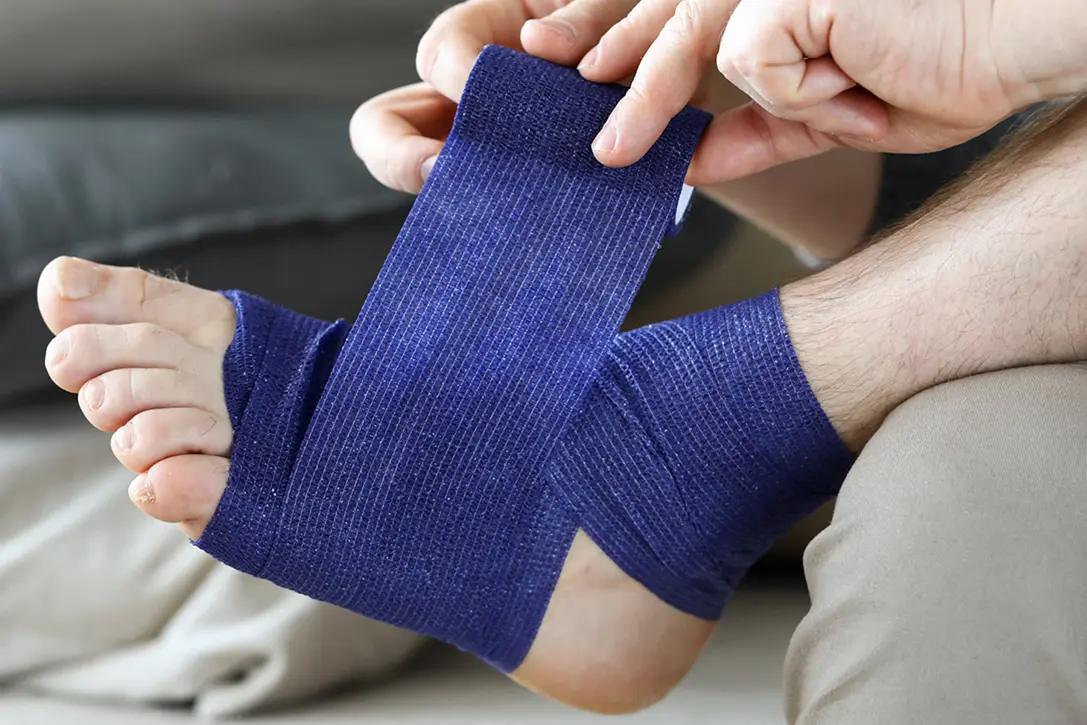
A sprained ankle is a frustrating and common injury. To avoid further problems, it is extremely important to take the aftercare seriously. If you have sprained your ankle, it should be bandaged immediately. Acting quickly helps to relieve pain and largely prevents further injury. When treating a sprained ankle, it is essential that it is also properly cared for. Incrediwear has compiled a guide to help you properly bandage a sprained ankle. This will help prevent the injury from worsening and allow the healing process to begin immediately.

Published on 02/12/2024
A Sprained ankle occurs when the ligaments in your ankle are overstretched. If they are completely torn, it is called a ligament sprain. Ligaments hold the ankle bones together and strengthen and stabilize the joint.
Ligaments have a limited range of motion because they move with the joint. A sprain occurs when ligaments are stretched and overstretched beyond their range of motion.
The following symptoms can be signs of a sprained ankle:
Using these symptoms It can be determined if you may have a sprained ankle. However, in such a case, it is recommended to seek the advice of a doctor who can provide a more accurate diagnosis.
If you believe you have sprained your ankle, and there is no improvement after a few days, you should definitely see a doctor. However, at the first signs of an injury, it is advisable to bandage the ankle immediately to begin the healing process right away.
If you have sprained your ankle or twisted your foot, you should bandage it as soon as possible. The bandage helps to stabilize the ankle, reduce swelling, and provide additional support to the foot. This support bandage takes pressure off the ligaments and prevents re-injury, allowing the ligaments to heal more quickly.
Effective treatment of a sprained ankle can help prevent long-term problems. Repeated sprains that do not heal properly can lead to chronic joint pain and weakness in the future. Proper treatment from the outset helps prevent joint weakness and minimizes the risk of re-injury.
Theoretically, anyone can bandage their ankle by simply wrapping it with a Bandage or wrap it with athletic tape. However, if you want to support the area and get the full benefit, you need to tape it in a specific way. This is how you effectively support the injured area and properly restrict movement. So, follow the steps below when treating a sprained ankle:
Before you bandage the ankle, the foot must lie flat and not be bent. Make sure the toes are not pointing up or down. It is helpful to start while lying down, as this way the foot points straight up and can be bandaged better. Make sure the ankle is not flexed and the foot forms a right angle with the leg.
With the ankle in a neutral position, you can begin to wrap the ankle with a soft pre-wrap. The pre-wrap protects the skin from the adhesive of the tape. The pre-wrap should be loosely wrapped around the ankle. Start in the middle of the foot, wrap around the ankle, and then continue spiraling up the leg until you reach the large calf muscle.
Start by wrapping the tape around the ankle to anchor it. Place four strips around the top of the pre-wrap where the skin is still exposed. Half of the tape should cover the skin, and the other half should cover the top of the pre-wrap so it doesn't fall down. The tape should be long enough to wrap around the width of the leg.
Next, secure the foot and leg. Apply a long piece of tape that runs from the tapered end down around the heel and back up to the tapered end on the other side.
Start by placing two pieces of tape around the ankle, each at the midpoint of the tape's length. After tearing off the edges, you should begin to wrap one tape spirally around the foot, with the ends pointing downwards at an angle towards the foot. Then, continue by pulling the second tape spirally up the leg. Each piece of tape should be long enough to wrap around the leg once.
After spiraling the tape up the leg, you should begin to wrap the foot, reinforcing the heel. Each piece of athletic tape should go across the top of the foot (at the ankle), then down around the heel, and back across the top of the foot to where the tape was initially placed. Finish the taping by wrapping the tape around the foot once.
Wrapping the ankle with a bandage is just as effective as taping, but the procedure is slightly different.
Just like when taping your ankle, you should start with your ankle in a natural position, without bending it. Place your leg on a flat surface with your toes pointing straight out.
It is helpful to start with a narrower bandage, which is easier to handle. An elastic bandage about five to twelve centimeters wide is easy to handle and allows you to effectively bandage your ankle.
Incrediwear offers a brace, containing a semiconductor material. This material has a greater effect than a standard bandage, as it generates cell vibrations that increase blood flow in the target area and improve the body's ability to promote nutrients and oxygen to the injured area.
This way, you relieve Incrediwear Bandages reduce inflammation, alleviate discomfort, and support recovery.
Place the end of the bandage on the instep (near the ankle) and begin to wrap the ankle towards the other leg. Wrap around the ankle twice. When bandaging, ensure you wrap more tightly towards the bottom of the foot and more loosely towards the upper part of the leg.
Just like with taping, you need to stabilize the ankle and prevent the foot from bending in any direction. Run the band around the bottom of the foot and then up and around the ankle. This prevents the foot from bending to the side and worsening the sprain.
Wrap the bandage upward around the lower part of the foot and ankle, maintaining the same length. Continue this process, gradually moving up the leg and then down the foot, until the ankle feels fully supported.
However, bandaging or taping the ankle is only part of the healing process.
In addition to bandaging, you should rest the ankle, apply ice, and elevate the leg to minimize swelling. Johanna Gregg, DNP FNP-C also recommends taking NSAIDs (non-steroidal anti-inflammatory drugs) for pain relief, as well as for gradually restoring activity tolerance and building strength.
If you fear your injury might worsen after recovery, or that your ankle will soon be fully strained by strenuous activities, you should wear a Ankle brace to consider. This additionally protects and supports the damaged joint.
While you are working on rehabilitating your sprained ankle, Incrediwear will continue to support it. Incrediwear was developed with technologies that improve blood circulation, accelerate recovery, and temporarily relieve pain.
This allows you to enjoy absolute comfort. The Incrediwear Bandage Selection ranging from ankle, knee, arm, and wrist bandages to two different wrap-around bandages that support their athletic performance in every situation.
Sources
Sprained Ankle – Symptoms and Causes | Mayo Clinic
Sprained Ankle: Symptoms, Types, Treatment, and Recovery | Cleveland Clinic
Why should I wrap my ankle? | Hughston Clinic
Text was from the blog of www.incrediwear.com Translated into German! | Medically reviewed by Johanna Gregg, DNP FNP-C
We are happy to provide you with further information and answer your questions personally.
We are happy to provide you with further information and answer your questions in person.
LOG IN
We have sent a 6-digit verification code to your email. Please enter it below to continue.
Register now to easily manage your orders and benefit from additional perks after your first purchase.
We have sent a 6-digit verification code to your email. Please enter it below to continue.
REGISTER NOW
We have sent a 6-digit verification code to your email. Please enter it below to continue.
We have sent a 6-digit verification code to your email. Please enter it below to continue.
We have sent a 6-digit verification code to your email. Please enter it below to continue.
Forgot password