

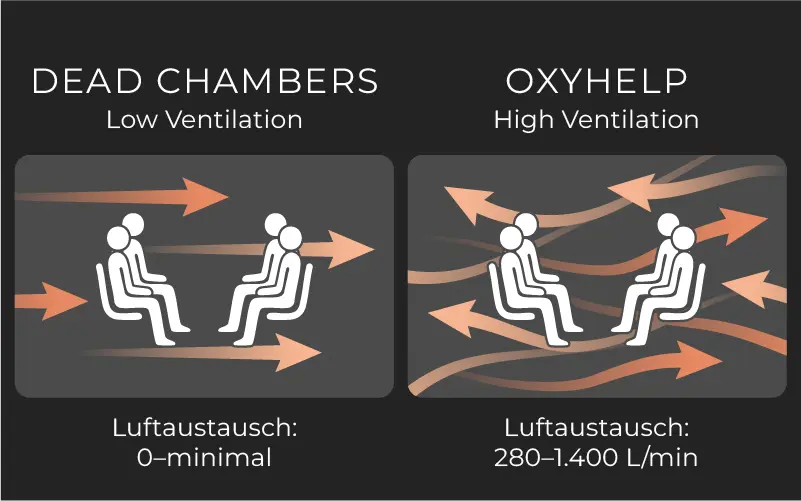
Many users assume that all hyperbaric chambers are built to the same safety standards. However, recent technical analyses reveal significant differences between modern, highly ventilated systems and older „dead chambers“ that operate with minimal or no air exchange.
This article scientifically explains why Hyperventilation a decisive factor for safety and health is – and why OXYHELP Technologies set new standards here.
Most of the pressure chambers available on the market operate on an outdated principle:
These so-called dead chambers look cost-effective at first glance, but they generate several safety-related risks that are actually no longer acceptable in modern HBOT standards.
Every person produces approximately. 200 ml of CO₂ per minute.
Without a continuous and sufficient supply of fresh air, the CO₂ level in the pressure chamber rises unnoticed. According to the European Code of Good Practice for HBOT, the CO2- However, the concentration must not exceed 0.5 % (5,000 ppm).
Immediate consequences of excessive CO2- content in the breathing air are:
CO₂ is odorless, so physical reactions can only be recognized late. At that point, one's own ability to react is already impaired.
Oxygen must not exceed in closed rooms – especially under pressure – 23 encore 23,5 % rise. This is the threshold limit value above which an atmosphere is considered oxygen-enriched and classified as highly flammable weird.
Even a small leak from an oxygen mask is enough to create dangerous O₂ hotspots in poorly ventilated chambers.
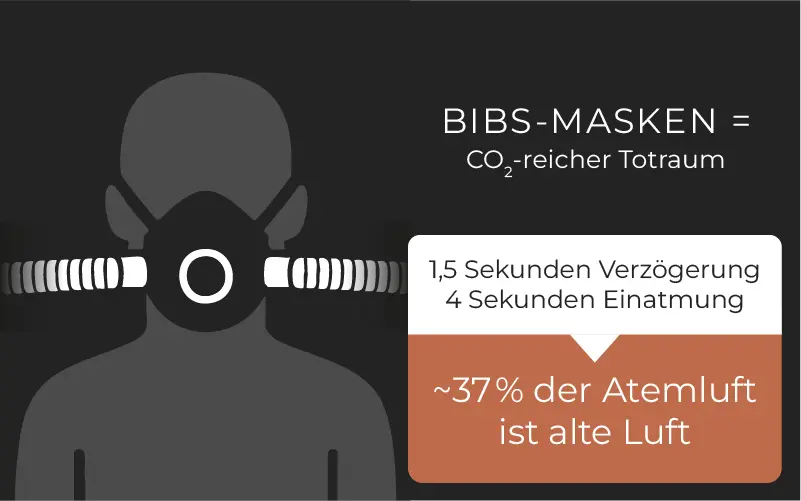
Due to the reduced ventilation, dead space systems force patients to inhale O₂ via BIBS Masks to breathe. But BIBS masks have one major drawback: the mechanical dead space.
A BIBS mask has a mechanical dead space and valve delays, which prevent a complete air exchange. For example, if a valve is delayed by 1.5 seconds, ~37% of the air just exhaled is inhaled again. Optimal airflow is no longer maintained, and the CO2-Levels in the body can exceed their target values. Headaches and dizziness can be the result.
In short:
Masks do not fix the problem – they make treatment more uncomfortable.
Modern HBOT standards recommend 60–80 liters of fresh air per person per minute.
OXYHELP with 233 liters/person of air exchange, it is deliberately and significantly exceeding that.
That means:
With a chamber size of approx. 10,500 liters and an air exchange rate of up to 1,400 l/min, a complete air exchange takes:
This isn't just a matter of convenience—it's a crucial safety advantage:
According to the European Code of Good Practice for HBOT Chambers and the safety manuals for hyperbaric medicine, the CO2-The concentration in the breathing air must remain below 0.5 % (5,000 ppm).
Many manufacturers measure the oxygen and CO₂ levels at the Air Intake – where the air is fresh and the readings are artificially low.
However, during a treatment, various CO2-Sources active. That is why OXYHELP measures the content at Outlet, where:
That means:
The figures are more realistic—and more reliable.
Many systems lead to 230 V or 110 V directly into the passenger compartment. This is a risky combination of electricity and oxygen, considering that there is a risk of fire even at an oxygen concentration of 23.5 %.
To ensure the highest possible level of security, OXYHELP on:
This drastically reduces the risk of ignition and fire.
The physiological explanation is simple:
CO₂ is the strongest respiratory drive. When it rises, stress also rises. When it remains low, relaxation is given.
Factor
Air exchange per chamber
Air exchange per person
CO2Control
O2-Safety
Respiration
Rebreathing of exhaled air
Comfort
Electrical safety
Measurement point
OXYHELP (High Ventilation)
280 – 1’400 lt/min
233 L/min
active
stable
Of course
very low
high
max. 24 V
Exhaust (critical)
Dead Chamber (Low Ventilation)
0 – minimal
~0 lt/min
passively hazardous
Hotspots > 23.5 %
Mandatory mask-wearing
high (dead space)
low
110 – 230 V
Inlet (distorted)
Modern hyperbaric oxygen therapy thrives on precision, safety, and comfort.
OXYHELP pursues an engineering-wise more demanding, but significantly safer approach:
✔ continuous hyperventilation
✔ safe oxygen levels
✔ low CO₂ concentration
✔ natural breathing without masks
✔ absolutely safe low voltage
✔ realistic monitoring
HBOT works best in a room that breathes – not in a room that stands still.
We are happy to provide you with further information and answer your questions personally.