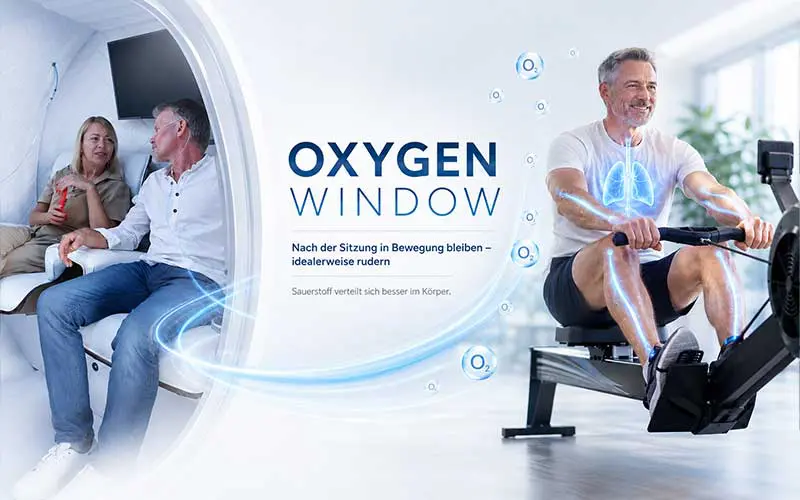
Many people assume that hyperbaric oxygen therapy (HBOT) ends as soon as they leave the pressure chamber. But strictly speaking, one of the most important phases begins right after: the so-called oxygen window. In this article, you will learn what the oxygen window is, why exercise is crucial during this phase, and how you can significantly increase the benefits of your hyperbaric sessions with simple measures.

Published on 05/13/2026
The Oxygen Window describes the period directly after a hyperbaric session in which your body continues to have above-average oxygen levels in your blood and tissues.
After a session, the oxygen remains:
This phase represents a unique physiological window of opportunity in which your body can utilize oxygen with particular efficiency.
Under normal conditions, your body primarily transports oxygen via hemoglobin in red blood cells. Blood plasma contains only a small amount of dissolved oxygen.
During a hyperbaric session, this changes significantly:
This means: Oxygen can penetrate deeper into the tissue – even into areas with restricted blood flow.
After leaving the pressure chamber, the pressure drops immediately – however, the oxygen remains in the body.
Key points:
This is the moment when you can decide:
Let the effect work passively – or use it actively.
Oxygen alone is not enough – how efficiently it is distributed in the body is crucial.
The basic equation is:
Oxygen Delivery = Cardiac Output × Oxygen Content
When you combine both, it creates a multiplicative effect that significantly improves your body's oxygen supply.
When you move within the Oxygen Window, several important effects occur:
1. Improved blood circulation
Your heart output increases from around 5 to 8–10 liters per minute. Oxygen is distributed more quickly throughout the body.
Muscle Pump Effect
Muscle movement supports the return flow of blood and improves circulation.
3. Opening of capillaries Additional small blood vessels are activated, which allows more oxygen to reach the tissue.
4. Increased energy requirements
Your muscles need more energy, which makes your mitochondria work more efficiently and produce more ATP.
5. Lymphatic System Activation
Waste materials, carbon dioxide, and flammable substances are removed more quickly.
Advantages:
Disadvantage
Advantages:
Disadvantage
Rowing is exceptionally well suited for utilizing the oxygen window, because:
This principle follows
Prepare -> Load -> Distribute
Many users report:
These effects correspond to known physiological mechanisms, but can vary individually.
Hyperbaric oxygen therapy significantly increases oxygen availability in your body. However, only through targeted exercise is this potential fully utilized.
The Oxygen Window is the most valuable phase after your session. If you actively use these 20-30 minutes, you can significantly increase the effect of your treatment.
Even 10–20 minutes of light exercise can make the difference between passive oxygen uptake and active, efficient utilization.
What is the Oxygen Window?
The oxygen window is the phase after a hyperbaric session in which your body still has elevated oxygen levels (approx. 20–30 minutes).
Do you have to train intensively?
No. Light movement is sufficient and optimal. It's about circulation, not exertion.
Why is exercise so important?
Because they distribute oxygen through the body faster and more efficiently.
Is rowing mandatory?
No, but particularly effective. Alternatives are:
What happens if you don't move?
The oxygen is used more slowly, and some of the potential remains unused.
Is that scientifically proven?
The physiological basis is scientifically proven. The specific application is based on these principles, but has not been specifically clinically studied.
Who is this suitable for?
For all those using Hyperbaric Oxygen Therapy, especially:
Are there any risks?
For healthy individuals and moderate exercise, the risks are low. If you have pre-existing conditions, you should consult a doctor.
How often should you use this?
Ideally after each hyperbaric session.
Can you improve your results through this?
Yes. They utilize the absorbed oxygen more actively and efficiently.
We look forward to hearing from you:
We are happy to provide you with further information and answer your questions in person.
LOG IN
We have sent a 6-digit verification code to your email. Please enter it below to continue.
Register now to easily manage your orders and benefit from additional perks after your first purchase.
We have sent a 6-digit verification code to your email. Please enter it below to continue.
REGISTER NOW
We have sent a 6-digit verification code to your email. Please enter it below to continue.
We have sent a 6-digit verification code to your email. Please enter it below to continue.
We have sent a 6-digit verification code to your email. Please enter it below to continue.
Forgot password