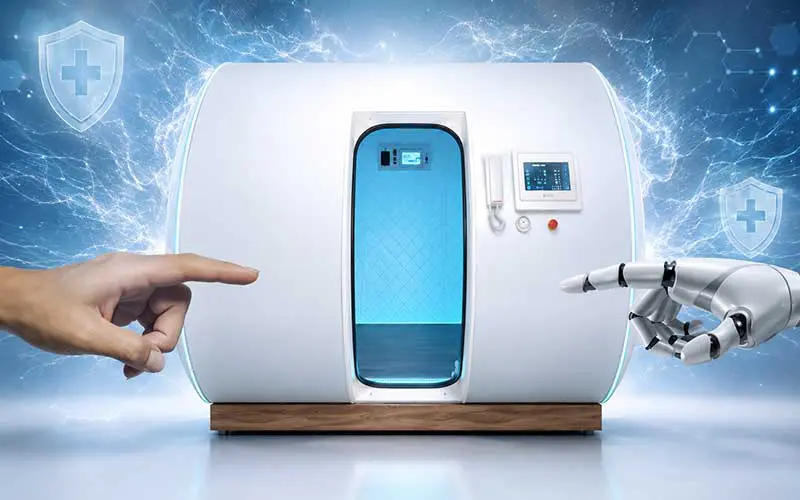
Hyperbaric oxygen therapy takes place in specially designed pressure chambers. However, not all pressure chambers are the same. When discussing safety, quality, and areas of application, a clear distinction must be made between high-pressure medical chambers and mild pressure chambers for longevity, prevention, recovery, and home use.

Published on 05/13/2026
This distinction is crucial because both systems fulfill different tasks. Medical hyperbaric chambers are part of clinical hyperbaric oxygen therapy, also known as HBOT. Mild pressure chambers, on the other hand, are a separate category for regular, comfortable, and prevention-oriented applications.
While medical hyperbaric chambers are used in hospitals and specialized facilities for defined indications (decompression sickness, carbon monoxide poisoning, burns, etc.), high-quality mild pressure chambers are ideal precisely where regular, comfortable, and preventative applications are the focus: in longevity clinics, health centers, recovery studios, and at home.
Therefore, the question of which chamber generates „more pressure“ is not crucial. What is crucial is which pressure chamber system can be used safely, with high quality, and responsibly for the respective intended purpose.
Medical hyperbaric chambers are typically located in hospitals, university clinics, wound care centers, or specialized hyperbaric medicine facilities. They are used there for clearly defined medical indications, which include, but are not limited to, decompression sickness, carbon monoxide poisoning, gas embolism, certain diabetic wounds, delayed radiation injury, necrotizing fasciitis, gas gangrene, and refractory osteomyelitis. UHMS (Undersea & Hyperbaric Medical Society) scientifically supported hyperbaric treatments are usually described in the range of 1.9 to 3.0 ATA and emphasizes that these treatments should be prescribed and monitored by qualified physicians.
In this context, the hyperbaric chamber is part of an overall medical system. This includes medical indication, medical information, structured treatment protocols, patient monitoring, trained specialist personnel, emergency management, technical maintenance, and documentation.
The Mayo Clinic also describes HBOT as a clinically supervised treatment using 100 % oxygen at up to three times normal atmospheric pressure, with monitoring by nursing staff. There, HBOT is described, among other things, as a therapy used to save lives, preserve tissue, or save limbs.
Medical hyperbaric chambers are therefore not primarily intended for wellness, longevity, or home use. They are used to treat specific medical conditions and belong in a professional medical setting with clear responsibilities.
Mild hyperbaric chambers serve a different purpose. They are not used as a substitute for high-pressure medical HBOT, but for regular applications in the areas of prevention, regeneration, recovery, sports, longevity, wellness, and home use.
That's precisely where their strength lies. In health centers, recovery studios, longevity clinics, and at home, it's not about acute emergency medicine, but about repeatable, comfortable, and everyday applications. For this purpose, a lower pressure range is not a disadvantage, but a deliberately chosen profile.
In the professional literature, „Mild Hyperbaric Oxygen“ is often classified as an application at pressures below 1.5 ATA. The UHMS describes „Mild Hyperbaric Oxygen Therapy“ as exposures below 1.5 ATA, while scientifically supported classical hyperbaric medical treatments are mostly between 1.9 and 3.0 ATA.
European professional societies describe low-pressure chambers in the context of mild hyperbaric applications with, among other things, relatively low pressure, for example, up to approximately 0.5 bar overpressure, which corresponds to about 1.5 ATA. At the same time, they emphasize ECHM European Committee for Hyperbaric Medicine EUBS (European Underwater and Baromedical Society) that safety, equipment, and indication issues must be taken seriously even at lower pressures. This means: Mild hyperbaric chambers are not weaker or inferior. They are optimized for a different area of application. A high-quality mild hyperbaric chamber does not need to imitate a hospital hyperbaric chamber. It must convince in its own area: through safety, comfort, high-quality materials, ease of operation, reliable pressure control, good instruction, and clear purpose.
When it comes to pressure chambers, pressure is often given in ATA or bar, which frequently leads to misunderstandings. Here's a brief explanation of the two terms:
ATA means „Atmosphere Absolute,“ which means „absolute atmosphere.“.
1 ATA corresponds to the absolute ambient pressure at sea level.
bar is a metric unit of pressure.
1 bar is approximately equal to the air pressure at sea level (exactly 1.01325 bar = 1 ATA): this small difference is often neglected in calculations, and it is generally calculated as 1 ATA = 1 bar.
The most important difference:
bar is a technical unit, while ATA is most often used when describing absolute pressure relative to atmospheric pressure.
Therefore, bar oft in zwei verschiedenen Angaben definiert:
a) Absolut Bar is like the absolute atmospheric pressure at ATA. This can vary depending on the altitude above sea level and weather conditions. If a pressure chamber is, for example, at an altitude of 1000 m, the ambient pressure is approximately 0.9 bar (900 mbar/hPa) absolute. In high pressure, it can be slightly higher, and in low pressure, slightly lower.
b) bar overpressure means additional pressure to normal ambient pressure.
Here are a few examples with pressure ratios when the chamber is at 0 m above sea level:
Here is an example with pressure conditions when the chamber is at 1000 m above sea level:
Therefore, for clear communication, it is important:
Mild hyperbaric chambers are particularly well-suited for longevity clinics, prevention centers, recovery studios, health centers, and high-end home use because they are designed and optimized for regular applications. This is precisely what is crucial in this field.
Longevity, prevention, and recovery are not about maximum pressure intensity. It's about a system that can be applied simply, safely, comfortably, and repeatedly. A mild pressure chamber can therefore be well integrated into health routines.
What's important is a serious formulation: The body of research on mild hyperbaric applications is significantly smaller than for classic medical HBOT. It does not prove that mild pressure chambers treat diseases, stop aging, or replace medical hyperbaric therapy. However, it does show that even lower hyperbaric pressure ranges can be physiologically active.
A study with 1.27 ATA hyperbaric air investigated ten healthy adults who received ten exposures over two weeks. Stem/progenitor cells were mobilized after repeated exposures; the authors see this as an indication that hyperbaric air can be biologically active and should be further investigated.
A randomized crossover study with 1.4 ATA and 35–40 % oxygen In 16 healthy young women, mild HBO exposure was followed by increased parasympathetic activity and a rise in NK cells. In this setting, certain oxidative stress and inflammatory markers did not increase.
A 2025 PLOS One study investigated 1.3 ATA and 35 % oxygen in 19 healthy men during an exercise ergometry test. The study found a higher ventilatory threshold and lower cardiopulmonary load parameters under the mild hyperbaric hyperoxic condition. The authors simultaneously emphasize that further research is needed before broad clinical applications can be derived from this.
Another controlled crossover study in 12 male Chinese university athletes examined 1.25 ATA and 26–28 % oxygen after a tiring cycling session. The study reported reduced subjective fatigue as well as faster recovery of heart rate and blood perfusion; after repeated sessions, certain markers related to muscle exertion, metabolism, and oxidative stress also improved.
This data makes mild pressure chambers particularly interesting for longevity, prevention, recovery, and home applications. However, it does not prove that mild pressure chambers can replace medical high-pressure chambers. Therefore, the correct statement is: Mild pressure areas can be physiologically active and, due to their lower pressure profile, are particularly well-suited for regular, comfortable, and preventive applications.
The term „mild“ is sometimes misunderstood. Mild does not mean inferior. Mild means that a lower pressure range is being worked with.
For longevity, prevention, and home use, that can be exactly an advantage. A lower pressure range can make the application more pleasant and better integrated into regular routines.
However, the quality of the system is crucial. A high-quality mild pressure chamber should not be sold based on maximum pressure, but rather on:
Especially in the longevity and prevention sector, this is the crucial point: it is not the highest pressure that makes the best chamber, but the optimal balance of safety, comfort, quality, and application concept.
Even though mild pressure chambers operate at lower pressure, safety remains a key issue. Oxygen, pressure, materials, and operation must work together.
The FDA reminds providers and facilities to follow the manufacturer’s instructions for HBOT devices, implement fire safety and security measures, be aware of the increased fire risk associated with high oxygen concentrations, use proper grounding, train staff, monitor patients during treatment, and follow the manufacturer’s instructions for cleaning, maintenance, and safety checks. The FDA also lists potentially prohibited items, electrical or static devices, and hyperbaric-appropriate clothing as relevant safety issues.
That does not mean that mild chambers are unsafe. It means that high-quality mild chambers should be developed and operated with the same seriousness as any other technical healthcare system.
You can recognize a safe, gentle pressure chamber by the fact that safety is not an afterthought, but rather an integral part of the design and concept from the very beginning.
The choice of materials is crucial for pressure chambers. This applies to medical high-pressure chambers just as much as it does to mild-pressure chambers.
For soft chambers, durability, stability, airtightness, ease of cleaning, and comfort are particularly important. Materials, seals, windows, zippers, valves, hoses, and connectors must be suitable for the intended pressure range and regular use.
A high-quality, gentle pressure chamber is therefore not simply a flexible, pressurized sleeve. It is a technical system in which the material, pressure control, oxygen supply, ventilation, operation, and safety mechanisms are all coordinated.
This is especially important for home use. The chamber must not only function properly from a technical standpoint, but also be easy to understand, reliable, and intuitive to use.
Oxygen itself is not flammable, but it is an oxidizer that can strongly promote combustion. Therefore, fire protection plays an important role in all hyperbaric chamber systems. The FDA explicitly points out the increased fire risk associated with high concentrations of oxygen and recommends, among other things, fire protection measures, grounding, training, monitoring, maintenance, and the restriction of prohibited items.
In practice, this means:
A good pressure chamber ensures safety not through fear, but through clear rules. Those who know what is and isn't allowed can use a mild chamber responsibly and with peace of mind.
Mild hyperbaric chambers are particularly appealing for home use because they allow for regular treatments without the need for constant appointments. This is precisely what makes them a major advantage for many longevity and preventive health programs.
However, ensuring that home use is effective and responsible requires more than just a good product. The following are important:
A high-quality, low-pressure chamber should therefore always be viewed as a complete system: the product, training, safety, and support all go hand in hand.
Precisely because mild hyperbaric chambers are becoming increasingly popular in the fields of longevity and preventive care, reliable communication is especially important.
Mild chambers should not be presented as if they were intended to replace hospital-based HBOT or to treat recognized medical indications on their own. The ECHM and EUBS expressly warn against promoting mild hyperbaric therapies with unverified claims and emphasize that even lower levels of pressure and oxygen exposure can raise safety and risk concerns.
This does not weaken the position of moderate chambers. On the contrary: it makes their correct positioning stronger.
A mild hyperbaric chamber is ideal for people and facilities focused on prevention, recovery, longevity, and regular health routines. However, it is not a substitute for medical diagnostics, not an emergency therapy, and not a replacement for medically necessary high-pressure HBOT.
This clear distinction builds trust.
| Category | Typical pressure range | Typical application |
|---|---|---|
| Normal environment | approx. 1.0 ATA | Daily life |
| Mild hyperbaric chamber | mostly approx. 1.3 – 1.5 ATA | Longevity prevention, recovery, wellness, home use |
| Transition area | approx. 1.5 – 1.9 ATA | depending on the system, protocol, and purpose – not clearly defined |
| Medical HBOT high-pressure chambers | mostly approx. 1.9 – 3.0 ATA | defined medical indications |
| Special recompression protocols | partly higher | special cases in diving medicine |
This table is to be understood as a guide. The decisive factors are always the specific intended use, oxygen administration, design, safety equipment, application, and regulatory classification. The UHMS cites 1.9 to 3.0 ATA as the usual range for scientifically supported hyperbaric treatments and classifies mild hyperbaric oxygen applications below 1.5 ATA.
You can identify a high-quality mild pressure chamber not by big advertising promises, but by concrete quality features such as:
Precisely these points make the difference between a simple chamber and a high-end premium solution.
Mild hyperbaric chambers should not be understood as „small hospital chambers.“ They are a distinct product category. They are of particular interest to people and facilities that think about health actively, preventatively, and long-term. These include:
What remains important: These environments are not about treating acute emergencies, but rather about modern healthcare routines. A mild hyperbaric chamber is a high-quality prevention and regeneration system, but it is not a replacement for medical diagnostics or medically necessary treatment.
The current state of research on mild hyperbaric applications is promising, but not yet as broad and established as the research on high-pressure medical HBOT for recognized indications. Therefore, it should be classified correctly.
| Study | Setting | Result | Serious classification |
|---|---|---|---|
| Mac Laughlin et al., 2023 | 1.27 ATA Ambient Air, 10 Healthy Adults, 10 Exposures | Mobilization of specific stem/progenitor cells | Evidence of physiological activity, but a small study without direct longevity endpoints |
| Nisa et al., 2023 | 1.4 ATA, 35–40 % oxygen, 16 healthy young women | Increased Parasympathetic Activity and Natural Killer Cells | Interesting for immune and regulatory parameters, but no statement on disease prevention |
| Hisamoto et al. 2025 | 1.3 ATA, 35 % oxygen, 19 healthy men during an exercise test | Improved aerobic metabolic parameters and lower cardiopulmonary load parameters | Relevant to recovery and performance research, but further clinical research is needed |
| Qu et al., 2024 | 2.25 ATA, 26–28 % oxygen, 12 male athletes after exercise | Less subjective fatigue, faster recovery of heart rate and blood perfusion | Interesting for sports recovery, but a small and specific sample size |
The fair summary is: Several small studies have shown that mild hyperbaric treatments produce physiological effects that are of interest for longevity, preventive care, and recovery approaches. However, they do not demonstrate any general therapeutic effect and are not a substitute for medical hyperbaric oxygen therapy (HBOT) for recognized indications.
Anyone who wants to buy or operate a mild hyperbaric chamber should ask a provider the following questions:
A reputable provider can answer these questions clearly and comprehensibly.
The safety of pressure chambers can only be properly assessed once it is clear what type of chamber is being referred to.
Medical high-pressure chambers are used in hospitals and specialized facilities for defined indications. They belong within a medically supervised treatment system with protocols, specialized personnel, emergency management, and medical documentation.
Mild hyperbaric chambers, on the other hand, are ideal precisely where regular, comfortable, and preventive applications are the focus: in longevity clinics, health centers, recovery studios, and at home.
You are not an inferior version of a medical hyperbaric chamber. You are a distinct, modern category for prevention, recovery, longevity, and high-end home use.
Therefore, the best pressure chamber is not automatically the one with the highest pressure. The best pressure chamber is the one that is used safely, is of high quality, and is suitable for the right purpose.
What is the difference between medical hyperbaric chambers and mild hyperbaric chambers?
Medical high-pressure chambers are used in hospitals or specialized facilities for defined medical indications. Mild pressure chambers, on the other hand, are primarily used in the fields of longevity, prevention, recovery, wellness, and for home use.
What pressure range do mild hyperbaric chambers operate in?
Mild pressure chambers typically operate in the lower pressure range, often between approximately 1.3 and 1.5 ATA. The UHMS classifies „Mild Hyperbaric Oxygen Therapy“ as exposures below 1.5 ATA.
From what point on is it considered medical HBOT?
Many classic medical HBOT protocols are in the range of about 1.9 to 3.0 ATA. The UHMS typically describes scientifically supported hyperbaric treatments in this range.
Is 2.0 ATA still mild?
2.0 ATA should not be broadly described as mild. In many professional classifications, 2.0 ATA is already in the range of classic medical HBOT.
Are mild pressure chambers worse than medical high-pressure chambers?
No. They are designed for a different purpose. High-pressure chambers are intended for medical indications. Mild pressure chambers are designed for longevity, prevention, recovery, and home use.
Why are mild hyperbaric chambers of interest for longevity and prevention?
Because they allow for regular, comfortable, and everyday applications in the lower pressure range. Several small studies show that mild hyperbaric pressure ranges can be physiologically active, for example regarding stem/progenitor cells, parasympathetic activity, NK cells, exertion parameters, or recovery markers. These results are interesting, but not proof of general healing effects or guaranteed longevity effects.
Can mild pressure chambers replace medical treatments?
No. Mild hyperbaric chambers should not be understood as a substitute for medical diagnostics or medically necessary high-pressure HBOT. They belong in the realm of prevention, longevity, recovery, and well-being.
What should you look out for when buying a mild hyperbaric chamber?
Important factors are pressure range, material quality, workmanship, safety mechanisms, emergency opening, oxygen concept, operating manual, maintenance, instruction, support, and honest communication without exaggerated healing promises.
Why is fire protection important even in mild chambers?
Because oxygen can promote combustion and safety rules must be observed even at lower pressure ranges. These include suitable clothing, no ignition sources, no unsuitable electronic devices, and compliance with the manufacturer's instructions.
Who is a mild hyperbaric chamber suitable for?
A mild hyperbaric chamber is suitable for people and institutions that value longevity, prevention, regeneration, recovery, and health-conscious routines. It is particularly useful when it is of high-quality craftsmanship, operated safely, and combined with good consultation.
1. UHMS – HBO Indications: Pressure ranges, recognized indications, delimitation of mild hyperbaric applications, and requirements for medical supervision.
2. FDA – Follow Instructions for Safe Use of Hyperbaric Oxygen Therapy Devices: Safety instructions regarding fire protection, grounding, training, monitoring, maintenance, cleaning, and prohibited items.
3. ECHM & EUBS – Joint Position Statement on “mild hyperbaric therapies”: European position on mild hyperbaric applications, safety requirements, MDR classification, and warning against unverified claims.
4. MacLaughlin et al., 2023 – Hyperbaric air mobilizes stem cells in humans: 1.27 ATA hyperbaric air, 10 healthy adults, mobilization of certain stem/progenitor cells.
5. Nisa et al., 2023 – Mild Hyperbaric Oxygen Exposure Enhances Peripheral Circulatory Natural Killer Cells in Healthy Young Women: 1.4 ATA, 35–40 % oxygen, parasympathetic activity, and NK cells.
6. Hisamoto et al., 2025 – Mild hyperbaric hyperoxia improves aerobic capacity and suppresses cardiopulmonary stress: 1.3 ATA, 35 % oxygen, exercise test in healthy men.
7. Qu et al., 2024 – Effects of mild hyperbaric oxygen therapy on timing sequence recovery of muscle fatigue: 1.25 ATA, 26–28 % oxygen, recovery from muscle fatigue in male athletes.
8. Mayo Clinic – Hyperbaric oxygen therapy: Clinical classification of HBOT, 100 % oxygen, up to three times normal pressure, medical supervision, and use for certain serious indications.
Note This article is not a substitute for medical advice. Medical symptoms, illnesses, or specific questions about treatment should always be discussed with qualified medical professionals. Mild pressure chambers should be used responsibly, in accordance with the manufacturer’s instructions, and for their intended purpose.
Wir freuen uns auf Ihre Kontaktaufnahme
We are happy to provide you with further information and answer your questions in person.
LOG IN
We have sent a 6-digit verification code to your email. Please enter it below to continue.
Register now to easily manage your orders and benefit from additional perks after your first purchase.
We have sent a 6-digit verification code to your email. Please enter it below to continue.
REGISTER NOW
We have sent a 6-digit verification code to your email. Please enter it below to continue.
We have sent a 6-digit verification code to your email. Please enter it below to continue.
We have sent a 6-digit verification code to your email. Please enter it below to continue.
Forgot password