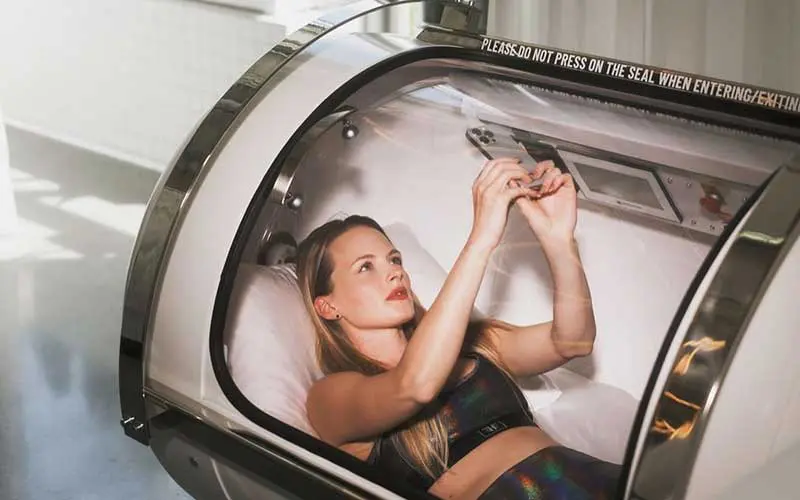
When choosing a hyperbaric oxygen chamber, most people think about pressure, oxygen, and technology – but rarely about the material of the viewports and doors. However, this very detail is crucial for safety. In this article, you will learn why polycarbonate is superior to traditional acrylic (PMMA) in modern hyperbaric chambers – and why this choice is not only a technical one but, above all, a safety-relevant one.

Published on 05/13/2026
The widespread use of acrylic is not based on modern hyperbaric applications, but rather on a completely different field of application: submarine technology.
In the 1960s and 1970s, standards such as ASME PVHO-1 were developed, based on:
Acrylic was sensible under these conditions because it:
-> But that's precisely where the problem lies:
These conditions have little in common with modern hyperbaric wellness chambers.
Today, hyperbaric chambers operate under completely different conditions:
That means:
The original advantage of acrylic – its scratch resistance – is today hardly relevant anymore.
The most important difference between acrylic and polycarbonate is not evident in everyday use – but in Edge case.
Acrylic (PMMA)
-> Result: catastrophic, unpredictable rupture.
Polycarbonate (PC)
-> Result: Controllable, recognizable deformation instead of explosion.
Ductile materials are safer than brittle materials.
Why?
Polycarbonate perfectly meet these criteria.
| Property | Acrylic (PMMA) | Polycarbonate (PC) |
|---|---|---|
| Failure mode | brittle (sudden fracture) | Ductile (Deformation) |
| Pre-warning | hardly any | clearly visible |
| Split risk | high | very low |
| Impact resistance | stomach | extremely high |
| User safety | critical | significantly higher |
An often-cited criticism of polycarbonate is so-called „creep“ (material deformation over time).
However, the context is crucial:
In practice, this effect irrelevant.
Another objection concerns so-called „environmental stress cracking.“.
This only occurs when two factors are present simultaneously:
In modern hyperbaric chambers:
The result: no relevant risk.
A common misconception: Polycarbonate is sensitive to oxygen.
Indeed, the following applies:
The material is coming not in contact with enriched oxygen.
Theory is important – practice is crucial.
Modern systems show:
This confirms: The material choice works in reality.
Polycarbonate also enable:
Acrylic would have to be considerably thicker for the same level of safety – with significant disadvantages for:
„Acrylic is the standard“
The standard is based on old applications, not on current conditions.
„Polycarbonate are less stable“
Incorrect. It is significantly more impact-resistant and fails more safely.
„Polycarbonate scratches more easily“
-> Correct, but purely cosmetic and easily solvable.
„Acrylic is safer“
On the contrary: brittle fracture behavior is the biggest risk.
The decision between acrylic and polycarbonate isn't a matter of tradition, but of modern engineering and safety.
Polycarbonate offers:
While acrylic was used for historical reasons, it is now clear:
Polycarbonate is the better choice for modern hyperbaric oxygen chambers.
We are happy to provide you with further information and answer your questions in person.
SIGN UP
We have sent a 6-digit verification code to your email. Please enter it below to continue.
Register now to easily manage your orders and benefit from additional perks after your first purchase.
We have sent a 6-digit verification code to your email. Please enter it below to continue.
Forgot password