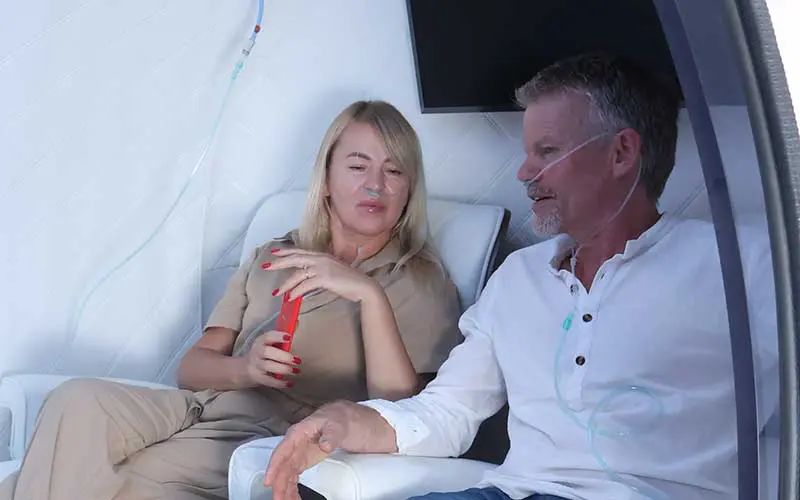
Hyperbaric oxygen therapy takes place in specially designed pressure chambers. However, not all pressure chambers are the same. When discussing safety, quality, and areas of application, a clear distinction must be made between high-pressure medical chambers and mild pressure chambers for longevity, prevention, recovery, and home use.

Published on 05/13/2026
In Hyperbaric Oxygen Therapy (HBOT), the focus is usually on one goal: absorbing as much oxygen as possible. But this is precisely where a critical fallacy arises.
For while many try to maximize the oxygen content, a crucial factor is often overlooked: the effective removal of carbon dioxide (CO2).
In this article, you will learn why the so-called „optimizing“ of oxygen through improper mask use can be counterproductive – and how to make your hyperbaric session truly safe and effective.
In practice, it repeatedly happens that users or operators:
The assumption behind this:
-> More oxygen = better therapy
Yet that is precisely a misconception.
Under hyperbaric conditions (e.g., at 1.5 ATA), your body is already in a state of extreme oxygen saturation.
That means:
-> The difference is physiologically negligible.
When you close the valves on a mask, the following happens:
That is called Rebreathing.
The human body reacts more strongly to CO2 than to oxygen.
Even small increases can lead to:
In more severe cases:
One particularly critical point:
-> Under hyperbaric conditions, your oxygen saturation (SpO2) at 100 %.
That means:
Many people then think, „The therapy is working.“
In reality, there might already be a CO2-overload (hypercapnia).
An adult produces about:
Due to poor breathing technique (short, rapid inhalation and exhalation) or hyperventilation (uncontrolled rapid breathing), part of the exhaled 2 re-inhaled. This is how the CO2- levels in the blood can quickly develop into a critical value:
Modern hyperbaric chambers are designed so that:
-> Goal: under 2,500 ppm CO2 inside the vehicle.
YET, when you seal a mask, here is what happens:
Many make a fundamental mistake in the sequence:
Wrong:
The correct answer is:
-> Exactly this order determines the success of the therapy!
Not every respiratory solution is equally suitable.
Particularly recommended:
-> Advantages:
Partially suitable:
-> Only at:
Not recommended:
-> High CO2-Risks.
-> No additional benefit.
When using hyperbaric sessions, please note:
-> These can be on CO2 point out – not to „good effect“.
More oxygen is not automatically better.
Hyperbaric therapy is not just about oxygen uptake, it is about a finely tuned balance between oxygen and CO2.
If you ignore this balance, you risk:
The most important takeaway:
Clean breathing is more important than maximum oxygen concentration.
Isn't more oxygen always better?
No. Beyond a certain point, more oxygen provides no additional benefit.
Why is CO2 So problematic?
Because your body is sensitive to it and it directly affects your breathing and your well-being.
How do I recognize too much CO2?
Typical signs are:
Can I measure that with a pulse oximeter?
No. It only shows oxygen, not CO2 an.
Which breathing method is best?
For most users:
Are masks generally bad?
No – only incorrectly used masks can be problematic.
What is the biggest mistake?
The sealing of the mask valves.
Why does this error happen so often?
Because many think that maximum oxygen supply automatically brings better results.
What is more important than oxygen?
The CO2-Removal and breathing comfort.
Does proper breathing improve therapy?
Yes – often significantly stronger than a minimal increase in oxygen concentration.
We look forward to hearing from you:
We are happy to provide you with further information and answer your questions in person.
LOG IN
We have sent a 6-digit verification code to your email. Please enter it below to continue.
Register now to easily manage your orders and benefit from additional perks after your first purchase.
We have sent a 6-digit verification code to your email. Please enter it below to continue.
REGISTER NOW
We have sent a 6-digit verification code to your email. Please enter it below to continue.
We have sent a 6-digit verification code to your email. Please enter it below to continue.
We have sent a 6-digit verification code to your email. Please enter it below to continue.
Forgot password