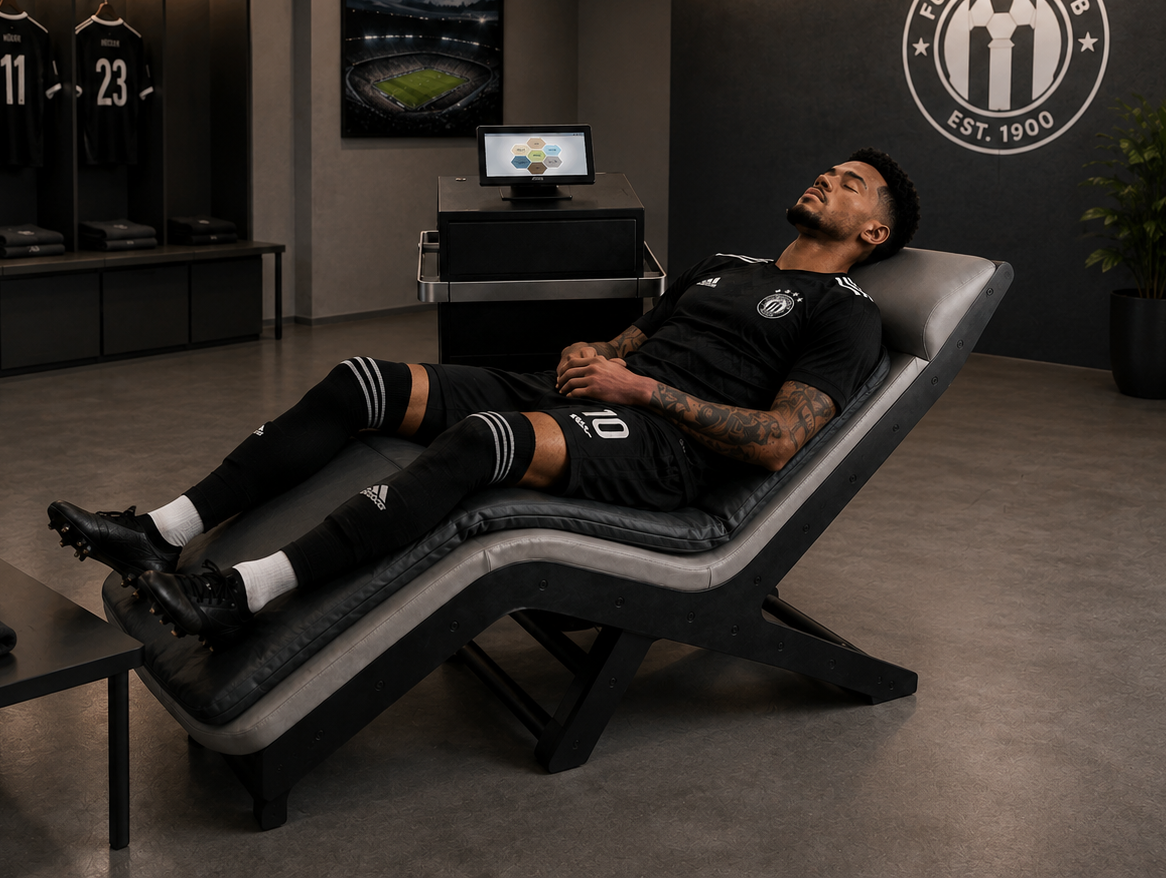
The underappreciated secret of sleep, jet lag, and neurophysiological regulation that 99% of professionals aren't yet taking advantage of. Competitive sports face a fundamental problem: They have become faster, more intense, and more global—but the athlete’s biological body has, at its core, remained the same as it has been for thousands of years.

Published on Nov 26, 2025
While training methods, equipment, nutrition, and data analysis are highly optimized today, one resource remains constantly limited:
And it is precisely this time that is becoming increasingly scarce in modern professional sports.
Competitions end late, travel takes place across multiple time zones, training schedules are tighter, and the pressure to perform is higher than ever. At the same time, the risk of injury increases dramatically in chronically sleep-deprived athletes. Studies clearly show: Sleep is one of the most important factors affecting performance, but it is still underestimated by most teams.
At the center of this challenge is a system that has become one of the most relevant tools in national teams, federations, Olympic structures, and performance hotels in recent years—including in our own projects:
A regeneration system that combines three technologies whose synergy produces an astonishingly powerful effect:
But why is this system particularly suitable for Sleep, Jet Lag, Rapid Parasympathetic Regulation and neurophysiological stabilization So exceptionally valuable? We are going to clarify that now – scientifically correct, excitingly explained, and with many practical insights from our work in elite sports.
Most athletes, coaches, and therapists initially think:
That's all true. But that's just the tip of the iceberg. The real, deeper truth is:
Because it directly interferes with the fundamental system that determines:
In short: It optimizes an athlete's biological core rhythm.
And whoever can influence an athlete's rhythm influences their entire performance economy.
Sleep is not a comfort zone—it is the biological foundation of:
Nevertheless, sleep in elite sports is often what is neglected the most.
Professional sports rarely take place during the day. Many events end at 9:00 PM, 10:00 PM, or 11:00 PM. Yet every sports physiologist knows:
After intense exertion, the nervous system is „locked in“ – the sympathetic nervous system keeps the body active.
What does it mean that:
An athlete in this condition cannot simply fall asleep – no matter how tired he feels.
The consequences: falling asleep too late, too little deep sleep, poor recovery.
The circadian rhythm is a highly precise internal system and depends on:
During jet lag are these clocks no longer running in sync. The consequence:
A typical pattern: A Swiss athlete who should now be sleeping in Beijing at 11:00 PM is biologically still in the early afternoon.
Without intervention, it takes 1–2 days per period (in our case, 7–14 days) until the system has readjusted. A disaster for professional sports!
After a competition, athletes are often in a state between:
That means: The transition from a competitive state to sleep is biologically blocked.
No supplement in the world can change this process in minutes. Breathing techniques can help, but are often too slow. Apps and tools seem too superficial.
A system is needed that directly accesses the primary control systems:
That is exactly what it does iMRS Prime!
The iMRS Prime combines three technologies that are already effective individually, but only unfold their full potential in combination.
PEMF stimulates electrical and magnetic processes in cells and in the nervous system. These effects are well documented scientifically:
In sleep science, PEMF is particularly valuable because it accelerates the nervous system's natural downregulation phase.
It usually takes the body 60–120 minutes to transition from a state of competition to a state where it is ready for sleep.
In our experience, with PEMF, it's often just 16–24 minutes. For many teams, this is a total game-changer.
Infrared is much more than just heat. In sleep science, the terms used are: Pre-Sleep Thermoregulation.
The body must lower its core body temperature to enter deep sleep. Far-infrared radiation provides:
This is the same mechanism that explains why taking a hot shower or going to the sauna in the evening can improve falling asleep.
With the iMRS Prime Here's how this effect works: faster, deeper and more controlled. Furthermore, the effect is amplified when combined with PEMF.
After an intense competition, the brain is primed for Beta– (Focus, Stress) or Gamma-Waves (intensive activation).
However, sleep requires:
Brainwave entrainment leads the brain faster, measurable and neurophysiologically sound exactly into these sequences.
Many athletes describe the process as: „as if the brain is being guided into a gentle landing“. A kind of neural landing system – and that is precisely what it is!
Jet lag is a system problem, not fatigue. It occurs when the following game players run asynchronously:
The iMRS Prime affects all six areas simultaneously. From teams and athletes, we have received the following insights and feedback based on long-term use:
-> Jet lag symptoms subside 30% to 50% faster.
-> Sleep quality improves significantly as early as the first night.
-> Athletes feel biologically „at home“—even if they’ve only been in the country for a short time.
This isn't just a "feeling"; it can be explained neurophysiologically.
Poor Sleep has been shown to lead to:
A An athlete who sleeps well against:
IMPORTANT: The iMRS Prime is not a wellness tool—it's a Power Factor.
„"The iMRS Prime shortens the time between peak performance and sleep—which, in sports, determines victory, injury, and the length of the season."“
Or, to be even more precise:
„"It is the only system that provides neurophysiological regulation for athletes before, during, and after competitions."“
Coaches, medical professionals, and athletic directors understand this right away—because it closes the biggest unresolved gap in sports.
We regularly work with:
The feedback – especially from the areas above – is exceptional:
Many athletes claim: „The iMRS Prime is the first system that truly brings me into rest mode after a competition.“
And coaches, physical therapists, and medical professionals say: „We haven't experienced a tool yet that influences sleep and jet lag so reliably.“
In elite sports, it is not only the ability to train that is decisive, but above all:
The iMRS Prime optimizes exactly these factors:
It is a system that biologically „slows down“ athletes so that they can return to peak performance more quickly.
In the next few years, we will see two types of teams:
We look forward to hearing from you:
We are happy to provide you with further information and answer your questions in person.
LOG IN
We have sent a 6-digit verification code to your email. Please enter it below to continue.
Register now to easily manage your orders and benefit from additional perks after your first purchase.
We have sent a 6-digit verification code to your email. Please enter it below to continue.
REGISTER NOW
We have sent a 6-digit verification code to your email. Please enter it below to continue.
We have sent a 6-digit verification code to your email. Please enter it below to continue.
We have sent a 6-digit verification code to your email. Please enter it below to continue.
Forgot password