


Radial extracorporeal shock wave therapy (rESWT) is a safe and effective treatment method for a variety of musculoskeletal disorders. Its efficacy depends on energy delivery at evidence-based, clinically relevant device settings.1 Therefore, in 2015, researchers began investigating how various rESWT devices differ in terms of their energy output.2
These differences were further investigated in a recent comparative study by Nina Reinhardt and colleagues at the Helmholtz Institute for Biomedical Engineering at RWTH Aachen University (Aachen, Germany).3 The authors of this study compared the latest EMS DolorClast® Radial Shock Waves device and a comparable device from a competitor. You found significant differences in the total energy that can be delivered to a patient.3
„RADIAL SHOCKWAVE DEVICES DIFFER SIGNIFICANTLY IN THEIR ENERGY OUTPUT“
Why is this important for practicing therapists? Because the latest scientific and clinical research has confirmed how important higher energy output is for better treatment outcomes. However, not all devices are capable of delivering high power. Read more about the amazing findings of this study.
In this in vitro study, two rESWT devices and their energy output at different settings were examined in a high-precision experimental setup:
The results of this study showed that the energy output varied between the two devices when the frequency setting (Pulse Repetition Rate, PRR) was increased:
The information is based on the following study: Influence of the Pulse Repetition Rate on the Acoustic Output of Ballistic Pressure Wave Devices Nina Reinhardt*, Jens Wegenaer & Matías de la Fuente
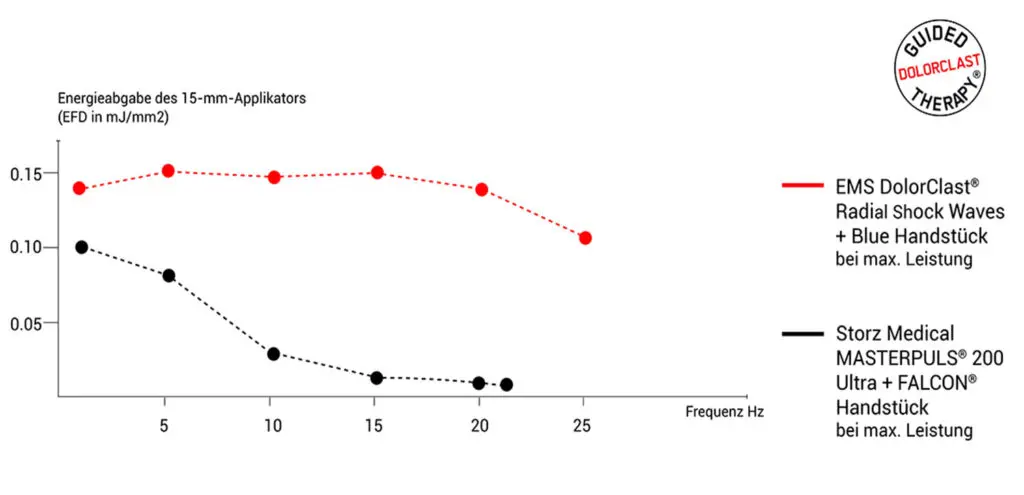
With the EMS DolorClast® Radial Shock Waves Device it has been possible to deliver clinically relevant energy outputs across all frequency levels. This is important for clinical practice because achieving results in a patient requires a sufficient delivery of energy to the tissue.
Reinhardt et al. (2022) concluded that the energy values specified by the manufacturer at 1 Hz do not guarantee the same results at higher frequencies.3 The study showed that the EMS DolorClast® The Radial Shock Waves device guarantees high energy output at all frequency settings.
For more than 20 years, EMS DolorClast has been based® based on clinical evidence: to achieve the best therapy outcomes, high-energy extracorporeal shock wave therapy has proven to be the most efficient. The high energy output of the EMS DolorClast® Radial Shock Waves are made possible by the combination of the compressors' highly effective air management and the unique design of the EVO BLUE and BLUE handpieces.5
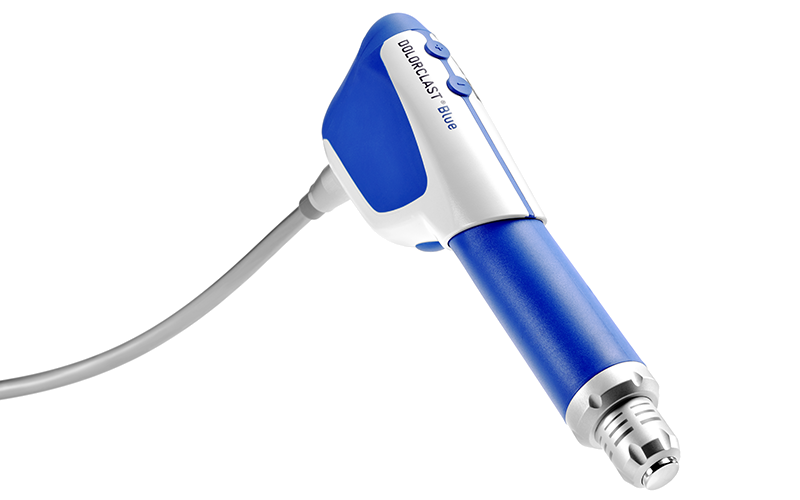
EMS has pushed the limits of physics to achieve maximum energy output across all frequencies, thereby successfully treating conditions in orthopedics and sports medicine:
1. The unique 2-compressor technology provides a constant air pressure for the DolorClast® BLUE handpiece.
2. Optimized air management in the handpiece for maximum projectile velocity.
The result is optimized radial extracorporeal shock waves that deliver a stable, reproducible, high level of energy to the treatment area. DolorClast® Radial Shock Waves delivers up to ten times more energy than the competitor's device.3
Compared to low-energy radial shockwave therapy, high-energy radial shockwave therapy leads to better therapeutic outcomes.
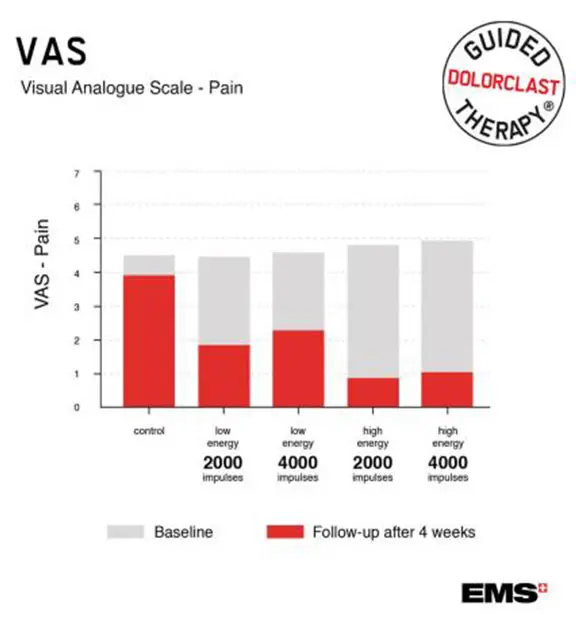
This was confirmed once again by a recent 2021 study, which investigated high- and low-energy radial extracorporeal shock wave therapy and its effects on pain relief (VAS) in patients with knee osteoarthritis.6 In this study, the DolorClast® EVO blue handpiece used with a 10 mm applicator at a shock frequency of 8 Hz.
This study showed that a high-energy therapy (0.24 mJ/mm2) led to a better therapeutic outcome than low-energy therapy (0.12 mJ/mm2).
Furthermore, the low energy could not be compensated for by increasing the number of shocks, as the latter did not lead to a better treatment outcome.6
Therefore, therapists should Select an rESWT device that offers a high energy output.
In a collaboration between researchers from Ludwig Maximilian University of Munich and the medical staff of an elite football team playing in the first or second German Bundesliga, the treatment and recovery times of 31 professional footballers, all of whom had acute muscle injuries, were evaluated retrospectively.7
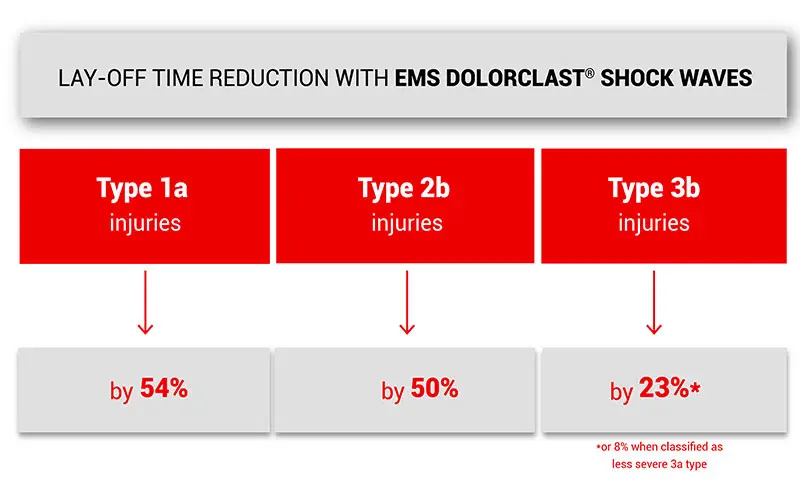
The main findings of this study were as follows:
The treatments in this study were performed at 20 Hz in the majority of cases. The positive results were achieved through the high energy delivery by the EMS DolorClast®- Devices used at high frequencies were connected.
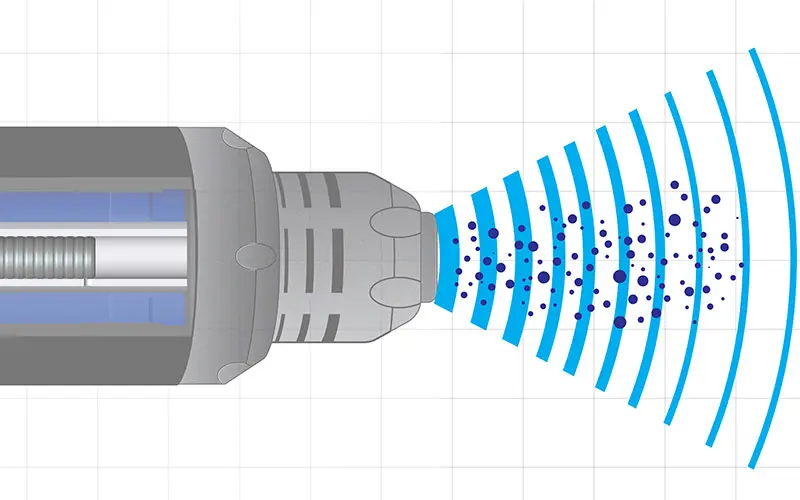
In short, if you Radial EMS DolorClast®Shock wave therapy device use, benefit from:
This is the goal of the Guided DolorClast® Therapy.
The experimental comparative study conducted by Reinhardt et al. (2022)3 has shown that the DolorClast® Radial Shock Waves device delivers a higher energy than the competitor's device – particularly at the high-frequency settings used in practice.3
„THE ONES WITH THE EMS DolorClast® EFFECTS ACHIEVED BY RADIAL SHOCK WAVE DEVICES CANNOT BE ATTAINED BY DEVICES WITH SIGNIFICANTLY LOWER ENERGY OUTPUT“
More than 50% All published level 1 clinical studies with a radial shock wave device were conducted using an EMS Dolorclast® device.1,8
In 80% of these studies, treatments with radial shock wave devices from EMS DolorClast showed® better clinical outcomes than the control groups.1
More than 60% across all studies, which demonstrated the cellular and biological effects of radial shock waves, were performed with EMS DolorClast®-performed devices.9
„THESE STUDY RESULTS MAY NOT APPLY TO OTHER RADIAL SHOCKWAVE DEVICES THAT DO NOT DELIVER THE SAME ENERGY.“
1) Schmitz C, Császár NB, Milz S, Schieker M, Maffulli N, Rompe JD, Furia JP. Efficacy and safety of extracorporeal shock wave therapy for orthopedic conditions: a systematic review on studies listed in the PEDro database. Br Med Bull 2015;116(1):115-38.
2) Császár NB, Angstman NB, Milz S, Sprecher CM, Kobel P, Farhat M, Furia JP, Schmitz C. Radial shock wave devices generate cavitation. PLoS One 2015;10(10):e0140541.
3) Reinhardt N, Wegenaer J, de la Fuente M. Influence of the pulse repetition rate on the acoustic output of ballistic pressure wave devices. Sci Rep 2022;12(1):18060.
4) Measured by the positive pulse intensity integral (which corresponds to the energy flux density; EFD)
5) The EVO Blue and the latest generation of the BLUE handpiece both use the same technology and therefore deliver nearly identical energy outputs. In contrast, the compressor technology and the power consumption measured in bar are of secondary importance, since the energy management and energy conversion in the handpiece are the decisive criteria for the energy delivery.
6) Zhang YF, Liu Y, Chou SW, Weng H. Dose-related effects of radial extracorporeal shock wave therapy for knee osteoarthritis: A randomized controlled trial. J Rehabil Med 2021;53(1):jrm00144.
7) Morgan JPM, Hamm M, Schmitz C, Brem MH. Return to play after treating acute muscle injuries in elite football players with radial extracorporeal shock wave therapy. J Orthop Surg Res 2021;16(1):708.
8) Randomized controlled clinical trials (Evidence-Based Medicine Level 1) are defined as studies that provide the highest level of evidence. This is a globally recognized research standard. research standard.
9) Wuerfel T, Schmitz C, Jokinen LLJ. The effects of the exposure of musculoskeletal tissue to extracorporeal shock waves. Biomedicines 2022;10(5):1084.
We are happy to provide you with further information and answer your questions personally.